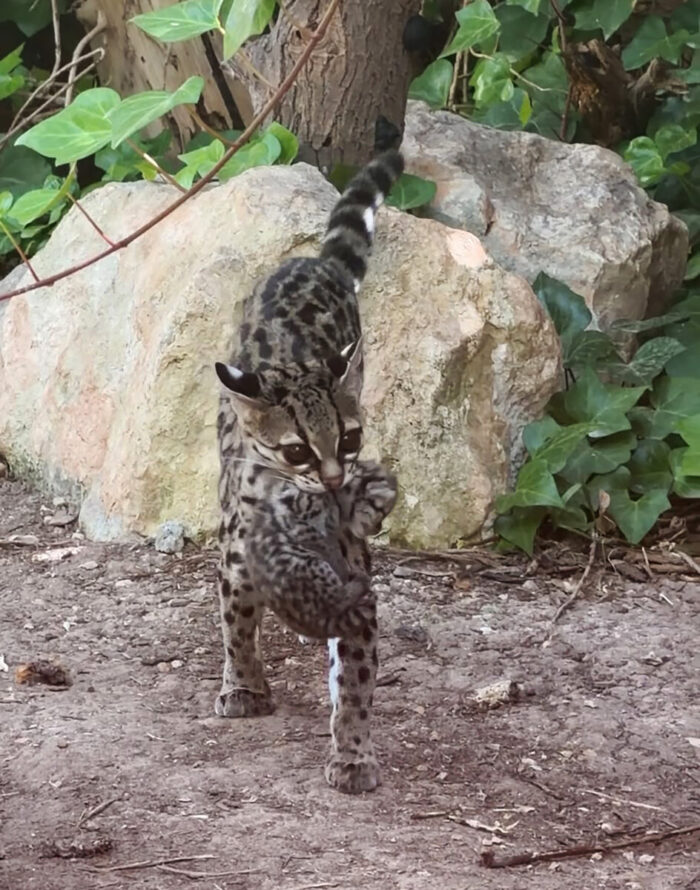
Terra Natura Benidorm achieves first successful breeding of the margay, a threatened small wild cat from Latin America
hace 1 monthWe are currently the only Spanish institution participating in the EAZA breeding programme for this species.
Terra Natura Benidorm has successfully achieved the first birth of a margay (Leopardus wiedii), a small wild cat native to Latin America and classified as Near Threatened by the International Union for Conservation of Nature (IUCN). The cub was born on 10 September, and both newborn and mother, Lecia, are in good overall health. At present, it has not yet been possible to determine the cub’s sex, so has not been given a name.
This birth represents an important milestone in our conservation work with the species, which is included in the European Endangered Species Programme (EEP), coordinated within the European Association of Zoos and Aquaria (EAZA). According to data from 2024, the population managed within the programme consisted of 70 individuals — 29 males, 40 females and one of undetermined sex — across 32 European institutions. Terra Natura Benidorm is currently the only Spanish institution participating in the programme with the margay.
We believe that the coordinated breeding of threatened species demonstrates the role that zoos can play as part of wider conservation strategies. By maintaining populations under professional human care and generating valuable knowledge, zoos can contribute to the long-term protection of species in the wild.
Since the breeding pair, Lecia and the male Goose, were introduced, we have closely monitored the female’s reproductive cycles and mating periods. The possibility of a pregnancy was considered based both on the dates recorded and on several physical changes observed in Lecia. This monitoring was complemented by camera traps, allowing us to observe the animals’ behaviour at night without interfering with their normal routines.
The margay’s gestation period lasts approximately 76 to 84 days and usually results in the birth of a single cub, although two cubs may occasionally be born. In this case, the young cub is growing quickly and appears to be developing normally. However, the first few weeks are a particularly sensitive period, so we are maintaining discreet and continuous monitoring while minimising any disturbance that could affect the bond between mother and cub.
For Lecia, this is also her first experience as a mother. Although she is in good overall health, she is still adapting to caring for her young and remains somewhat nervous. With first-time mothers, it is particularly important to provide a calm and secure environment that encourages the development of natural maternal behaviour. So far, her progress has been positive, although the cub has not yet completely passed through this particularly vulnerable early stage.
The relationship between Lecia and Goose has been positive since they were paired. However, the male is being kept separate during the birth and the cub’s early stages of life due to the characteristics of the species and the vulnerability of young margays during their first few months. This management approach follows the recommendations of conservation breeding programmes and aims to minimise risks during this particularly delicate period.
The margay is one of the wild cats best adapted to an arboreal lifestyle. One of its most remarkable characteristics is its ability to rotate its hind feet, allowing it to climb down tree trunks head first and even hang from branches using its feet. Outside the breeding season, it is mainly solitary, with males and females forming temporary associations.
Habitat loss and fragmentation are currently the species’ main threats. These are compounded by the expansion of agricultural and livestock areas, roads, the illegal trade in individuals as pets and in skins, and retaliatory killings linked to attacks on poultry. Historically, the species also faced intense pressure from the fur trade, while some populations are now highly fragmented as a result of habitat transformation.
“Having the margay within the EAZA programme gives us an opportunity to raise awareness among our visitors about the importance of this species within ecosystems and the threats it faces in the wild. We believe that education and awareness are a fundamental first step towards creating a connection with these species, promoting research and contributing to their conservation,” says Terra Natura Benidorm.
Over the coming weeks, we will continue to discreetly monitor Lecia and her cub, keeping interference to a minimum while closely observing their progress during this early stage. Our participation in the European programme allows us to contribute to the coordinated management of the population under human care while also bringing the conservation of lesser-known small wild cats closer to the public.