Solar eclipse triggers unusual vocalisations in elephants, flamingos and barasinghas, while squirrel monkeys show behavioural changes
hace 2 monthsAt Terra Natura Benidorm, we have analysed the behaviour of several animal species during last Wednesday’s solar eclipse and observed some unusual patterns among our Asian elephants, squirrel monkeys, flamingos and barasinghas, one of the deer species living in our meadow.
One of the most striking observations was an increase in vocal activity and the appearance of unusual vocalisations coinciding with the peak intensity of the eclipse. This behaviour was particularly noticeable among the flamingos and barasinghas, species that do not normally display this level of vocal activity at that time of day.
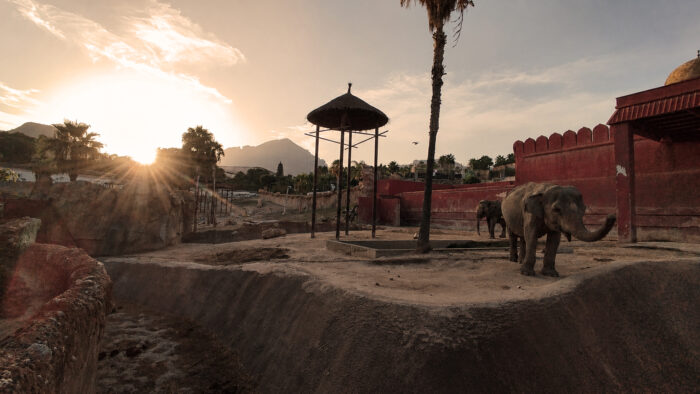
In the case of our Asian elephants, the recording cameras did not detect any significant changes to their routines in the hours leading up to or during the eclipse. Apart from one exceptional vocalisation recorded at the moment of greatest darkness, their behaviour remained within normal parameters.
“Their behaviour was fairly normal overall. We believe this may be because the eclipse occurred relatively late in the afternoon, meaning that the change in light levels was not particularly noticeable. However, at the peak of totality, one of the elephants produced low-frequency vocalisations that could potentially be linked to the sudden darkness,” explains one of the researchers responsible for the study at Terra Natura Benidorm.
The vocalisations recorded among the flamingos and barasinghas were particularly noteworthy for our team.
“We were surprised to see these animals vocalising during the eclipse at a time when they do not usually do so, and to observe this activity continuing during the most intense phase of the phenomenon,” the researcher explains.
Slight confusion observed among squirrel monkeys
We also used cameras to monitor the behaviour of our squirrel monkeys throughout the day of the eclipse. During the period of maximum darkness we observed a few moments of apparent confusion.
During this period, the animals moved to the upper area of their enclosure, a space they normally use for sleeping at night. However, as soon as light levels began to increase again, they quickly returned to their usual activity and resumed everyday behaviours such as feeding.
A study coordinated by AIZA
The recordings and observations carried out at Terra Natura Benidorm are part of a project coordinated by the Iberian Association of Zoos and Aquariums (AIZA), involving around a dozen zoological and wildlife centres across Spain and Portugal.
The aim of the initiative is to gather information on the behaviour of different species during solar eclipses and identify any potential changes in their routines, movements, social interactions, activity levels and resting habits. The limited number of coordinated scientific studies carried out in zoological institutions makes these phenomena a valuable opportunity to expand our understanding of how wildlife responds to sudden changes in lighting conditions.
The project will continue during the next solar eclipse from Spain and Portugal, scheduled for August 2027 and January 2028. The intention is to continue monitoring the behaviour of selected species in order to build a larger dataset and identify potential behavioural patterns.
Once the data collection phase has been completed, AIZA will analyse the material gathered by the participating centres and produce an informative audiovisual document presenting the project’s main findings.
For us at Terra Natura Benidorm, taking part in this initiative represents another valuable opportunity to contribute to research and raise awareness of the behaviour of the species within our zoological collection.
Alongside Terra Natura Benidorm, the AIZA-coordinated project involves Zoo de Santillana del Mar, Parque de la Naturaleza de Cabárceno, Lacuniacha, Rio Safari Elche, Oceanogràfic de Valencia, Bioparc Fuengirola, Sendaviva, Tierra Rapaz, Faunia, Zoo de Madrid and Zoomarine in Portugal.